
Standard hooks are not built for complex loads, leading to increased reliance on insecure and unsteady rigging practices. By basing our designs around your lifting requirements, Reading’s customized material handling devices protect your staff, products, and facility, allowing you to move delicate, unbalanced, and oddly shaped loads in a safe, controlled manner.
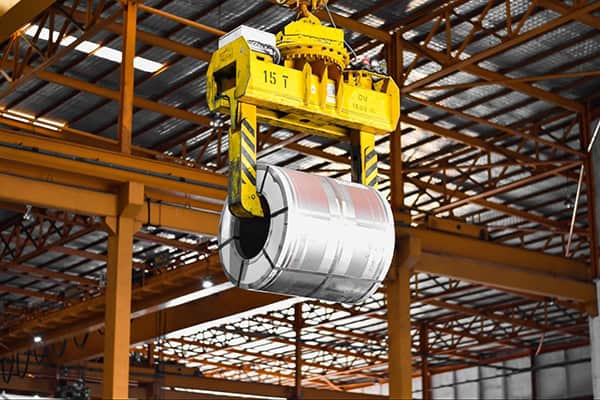
Designed for Your Specific Load
Because they concentrate lifting forces, slings and chokers are not the best choice for delicate and irregular objects, such as:
- Steel Coils
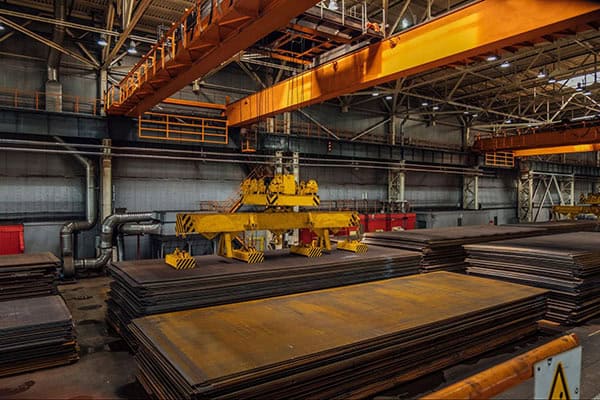
- Metal Plates
- Turbine Blades
- Airplane Assemblies
- Castings and Forgings
To ensure safe handling, Reading Crane & Engineering builds customized solutions designed to cushion fragile loads, protect finished surfaces, and distribute weight evenly.
We begin by assessing your average load, including its weight, dimensions, and center of gravity. Contact temperature and material finish are also considered, along with clearance, lifting capacity, and available headroom, to avoid damage, prevent accidents, and ensure efficient movement within your facility, no matter how complex the load.
Engineered Material-Handling Capabilities
Reading engineers and manufactures specialized lifting systems that can be added directly to your existing cranes, creating an integrated system capable of transferring materials between workstations, production lines, and storage areas in a precise, predictable manner.
Our devices improve load control, providing a practical solution for round, tapered, or asymmetrical shapes unsuited to slings, while also reducing the risk of damage and protecting operators from falls and slippage.
Reading Crane & Engineering offers a wide range of purpose-built, below-the-hook devices designed to address common material-handling challenges.
- Spreader Beams. Distribute weight across multiple lift points
- Coil Hooks. Lift heavy coiled loads from their central opening
- Magnetic Lifters. Secure ferrous metal loads with electromagnetic fields
- Vacuum Lifters. Hoist materials using suction pads to create a vacuum seal
- Tongs and Clamps. Grab irregular loads with a set of retractable jaws
Safety and OSHA Compliance
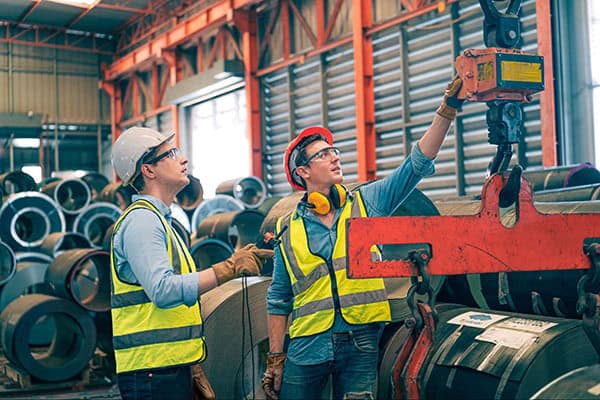
Every piece of equipment produced by Reading is thoroughly tested to ensure it meets the strict standards set down by the American Society of Mechanical Engineers. These procedures allow our experts to:
- Determine the maximum rated load
- Verify that all stresses remain below acceptable limits
- Identify signs of structural fatigue
Rigorous testing ensures every device we send out into the field can meet the demands placed upon it, not just for a single lift, but over its entire lifespan.
Ready to Optimize Your Lifting Operations?
Reading has been building cranes for over a century, collaborating with customers to ensure materials are handled safely and efficiently, regardless of their size, weight, or shape. By tailoring equipment to your operation, we ensure operators can safely lift, move, and position objects, leading to better workflow and higher output.
Material Handling FAQs
-
What is the difference between a crane and material handling equipment?
Material handling equipment is a broad category describing any machine used to move goods from one location to another. Cranes are a subset of material handling equipment designed to move materials vertically and horizontally within a facility or worksite.
-
How do I know if my facility needs a custom lifting solution?
If standard lifting equipment is incapable of keeping up with the demands of your operation, you need a custom solution. Complex rigging, product damage, and frequent slippages are common signs that regular below-the-hook devices cannot handle the materials you work with.
-
How does engineered material handling prevent product damage?
By distributing weight evenly, customized below-the-hook devices minimize compressive stress, which can crack, dent, scratch, or deform your products. At the same time, they create secure attachment points that prevent loads from slipping and falling during transit.
-
What are the most common types of material handling solutions?
In addition to hooks and slings, the most common types of below-the-hook attachments are clamps, C-hooks, spreader beams, plate lifters, pallet lifters, magnetic lifters, and vacuum lifters.
-
Can custom material handling equipment be integrated into my existing overhead crane?
Yes. Reading engineers can easily incorporate new below-the-hook devices into your existing cranes. In many cases, we base our designs on your current system, to ensure it fits seamlessly with your equipment.
Quality Comes First
We Make Sure That Every Minute Detail Is Looked Into While Manufacturing Even The Smallest Product. Our Focus Is 100% On Client Needs And Satisfaction.
